
Custom Mandibular Advancement Device
Are You Experiencing Problems with Snoring?
Snoring may sometimes be a simple sleep-quality concern. However, in certain individuals, it may be associated with Obstructive Sleep Apnea (OSA) — a condition that requires proper medical evaluation.
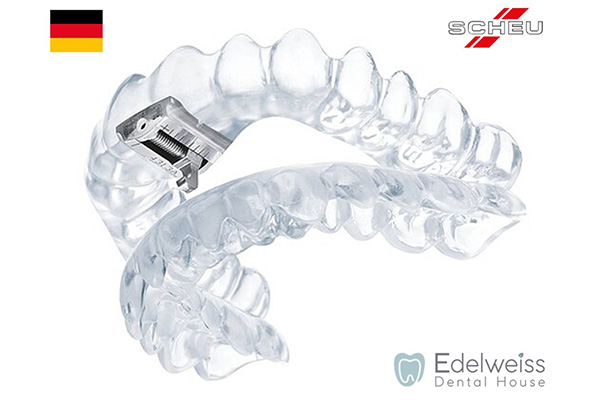
At Edelweiss Dental House, we provide custom-made anti-snoring devices, also known as oral appliances or mandibular advancement devices (MAD). These devices are medically recognized as an appropriate treatment option for individuals with primary snoring or mild to moderate OSA, as well as for patients who are unable to tolerate CPAP therapy consistently.
Our approach emphasizes thorough evaluation and individualized treatment planning. Depending on your condition, this may include further diagnostic assessment or consideration of an oral appliance as part of your care plan.
If you would like to learn more, our dental team is happy to provide clear and evidence-based information to help you make an informed decision.
You may read the detailed information below to better understand snoring, obstructive sleep apnea, and the role of oral appliance therapy in treatment.
Understanding Snoring, Obstructive Sleep Apnea, and the Role of Oral Appliance (Mandibular Advancement) Therapy
What Causes Snoring?
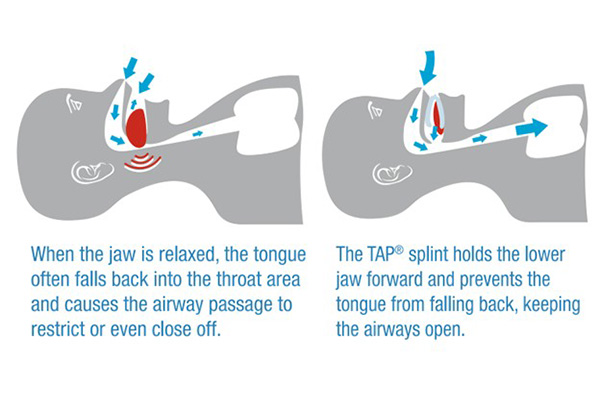
Snoring occurs when the soft tissues of the upper airway vibrate during sleep. As muscles in the throat relax, the airway narrows. Airflow through this narrowed passage causes tissue vibration, producing the familiar snoring sound.
For some individuals, snoring is primarily a social or quality-of-life concern.
For others, it may be associated with Obstructive Sleep Apnea (OSA) — a medical condition characterized by repeated airway collapse during sleep.
Untreated OSA may contribute to:
- High blood pressure
- Cardiovascular disease
- Daytime fatigue
- Reduced cognitive performance
- Poor overall sleep quality
Many patients begin by searching terms such as:
- anti snoring device
- snoring mouthguard
- anti-snoring mouthpiece
- mandibular advancement device
- oral appliance for sleep apnea
However, selecting a solution without proper evaluation may not address the underlying condition.
Proper Evaluation Comes First
Before choosing any anti-snoring treatment, it is important to determine whether the issue is:
- Primary snoring
- Mild OSA
- Moderate OSA
- Severe OSA
The medical gold standard for diagnosis is a Sleep Study (Polysomnography).
A sleep study measures breathing patterns, oxygen levels, and sleep stages, helping determine the severity of the condition and guiding appropriate treatment selection.
CPAP: The Established Standard of Care
Continuous Positive Airway Pressure (CPAP) therapy is widely recognized as the standard treatment for moderate to severe OSA.
CPAP works by delivering pressurized air to prevent airway collapse during sleep. It is highly effective in reducing the Apnea–Hypopnea Index (AHI).
However, long-term success depends on consistent nightly use. Some patients may experience:
- Discomfort
- Difficulty tolerating the mask
- Interrupted adherence
While CPAP remains the most effective therapy in reducing AHI, real-world outcomes also depend on whether the patient can comfortably and consistently use the device.
The most effective treatment is not only the one that performs best in clinical trials, but the one a patient can realistically use every night.
What Is an Oral Appliance (Mandibular Advancement Device)?
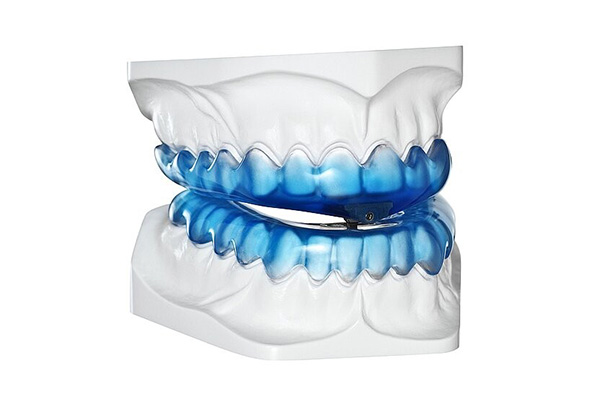
An Oral Appliance, also known as a Mandibular Advancement Device (MAD), is a custom-fitted intraoral device worn during sleep.
In many markets, it may be referred to as:
- Anti-snoring mouthpiece
- Snoring mouthguard
- Anti snoring dental device
- Mandibular advancement splint
The medical principle behind the device is mandibular advancement — gently repositioning the lower jaw forward during sleep.
This forward positioning:
- Enlarges the upper airway
- Reduces airway collapse
- Minimizes soft tissue vibration
- Improves airflow stability
Oral appliance therapy is supported by clinical guidelines, particularly for:
- Primary snoring
- Mild to moderate OSA
- Patients who cannot tolerate CPAP
Our clinic utilizes the TAP® T appliance system by Scheu Dental (Germany), a precision-engineered mandibular advancement device designed for controlled, incremental jaw positioning.
This system allows accurate titration of mandibular advancement while maintaining stability and comfort during sleep. The appliance is individually fabricated and adjusted based on each patient’s occlusion and clinical assessment.
How Oral Appliance Therapy Compares to CPAP
CPAP generally produces greater reductions in AHI.
However, multiple studies suggest that oral appliance therapy may achieve comparable health outcomes in selected patients due to:
- Higher comfort levels
- Better long-term adherence
- Greater ease of use during travel
For appropriately selected individuals, an oral appliance can be an effective and practical anti-snoring solution.
Importantly, oral appliance therapy does not replace CPAP in all cases. Treatment decisions should be individualized.
Custom-Made vs Over-the-Counter Anti-Snoring Devices
Over-the-counter anti-snoring mouthpieces and boil-and-bite snoring mouthguards are widely available.
However, these devices:
- Are not customized to individual bite relationships
- Do not allow controlled titration of mandibular advancement
- May increase risk of jaw discomfort or bite changes
A professionally fabricated custom mandibular advancement device is designed based on:
- Occlusion (bite relationship)
- Temporomandibular joint (TMJ) health
- Controlled advancement calibration
- Follow-up monitoring
This ensures both effectiveness and long-term safety.
Who Is a Good Candidate for an Oral Appliance?
Oral appliance therapy may be appropriate for individuals who:
- Experience chronic snoring
- Have mild to moderate OSA
- Are intolerant of CPAP
- Prefer a portable anti-snoring solution
A comprehensive evaluation is essential before starting therapy.
Frequently Asked Questions
Does an anti-snoring mouthpiece really work?
Yes, mandibular advancement devices have strong clinical evidence supporting their effectiveness for snoring and mild to moderate OSA. Success depends on proper diagnosis, customization, and follow-up.
Can an oral appliance replace CPAP?
CPAP remains the standard for moderate to severe OSA.
Oral appliances are recommended for mild to moderate OSA or for patients who cannot tolerate CPAP. The decision should be individualized.
Is a snoring mouthguard safe?
Over-the-counter devices may be safe for short-term use but lack professional monitoring. Custom-made devices fitted by a dentist reduce risks related to jaw discomfort or occlusal changes.
References
- Epstein LJ, Kristo D, Strollo PJ Jr, Friedman N, Malhotra A, Patil SP, et al. Clinical guideline for the evaluation, management and long-term care of obstructive sleep apnea in adults. J Clin Sleep Med. 2009;5(3):263–76.
- Ramar K, Dort LC, Katz SG, Lettieri CJ, Harrod CG, Thomas SM, et al. Clinical practice guideline for the treatment of obstructive sleep apnea and snoring with oral appliance therapy: an update for 2015. J Clin Sleep Med. 2015;11(7):773–827. doi:10.5664/jcsm.4858.
- Sutherland K, Vanderveken OM, Tsuda H, Marklund M, Gagnadoux F, Kushida CA, et al. Oral appliance treatment for obstructive sleep apnea: an update. J Clin Sleep Med. 2014;10(2):215–27. doi:10.5664/jcsm.3460.
- Phillips CL, Grunstein RR, Darendeliler MA, Mihailidou AS, Srinivasan VK, Yee BJ, et al. Health outcomes of continuous positive airway pressure versus oral appliance treatment for obstructive sleep apnea: a randomized controlled trial. Am J Respir Crit Care Med. 2013;187(8):879–87. doi:10.1164/rccm.201212-2223OC.